The Hijri calendar
An interactive Islamic calendar with moon phases, Islamic events, and Gregorian conversion — following the moon-sighting authority you choose.
On this page
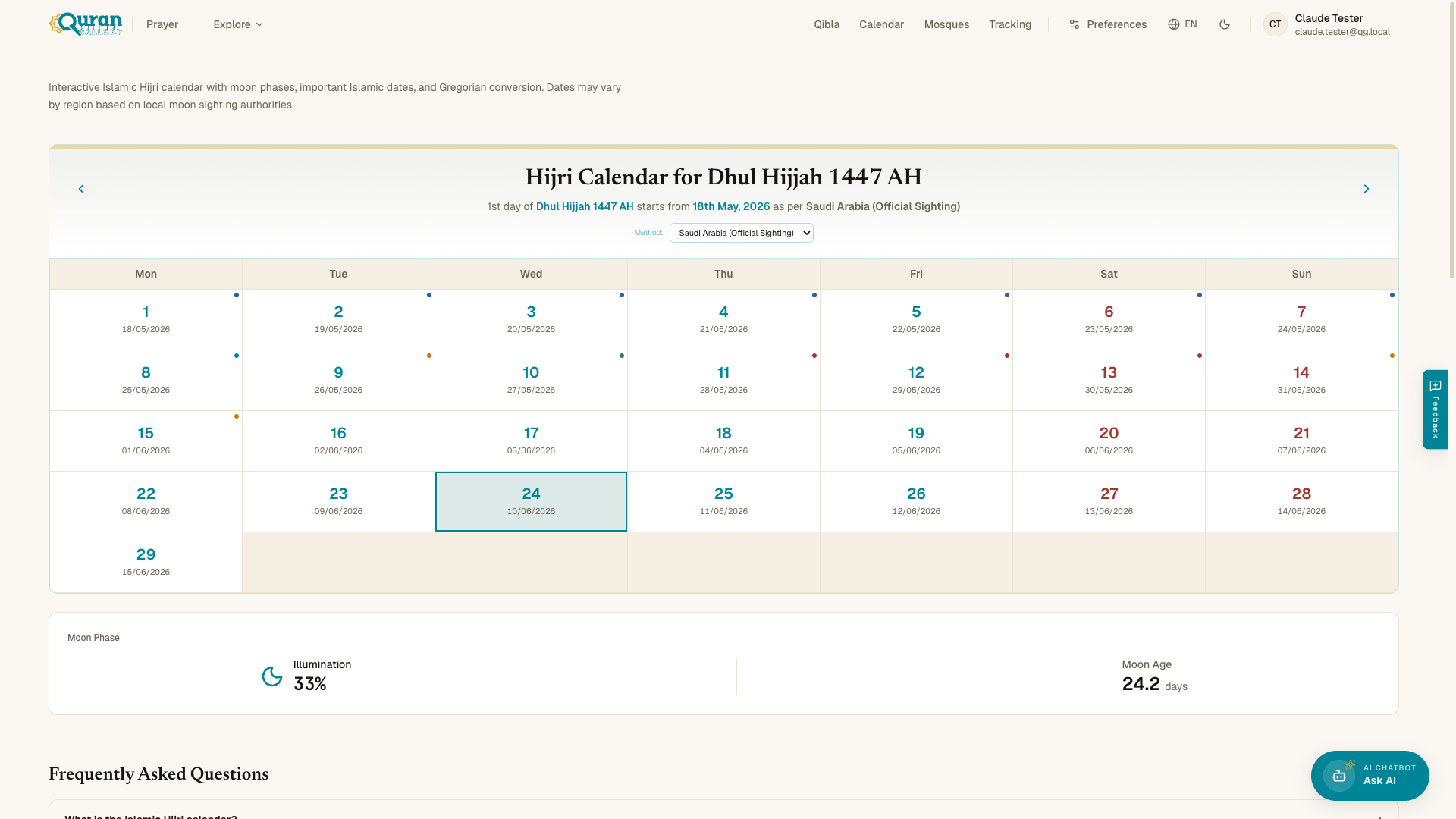
The Hijri calendar at qurangallery.com/prayer/calendar is an interactive Islamic calendar with moon phases, important Islamic dates, and Gregorian conversion. Because an Islamic month begins with the sighting of the new moon, the same date can differ by a day between regions — so the calendar lets you choose which authority to follow.
Choosing a method
The Method dropdown offers eight ways to anchor the month:
| Method | What it follows |
|---|---|
| Saudi Arabia (Official Sighting) | The kingdom’s official moon-sighting announcements. The default. |
| Umm al-Qura (Calculated) | Saudi Arabia’s calculated Umm al-Qura calendar. |
| Diyanet (Turkey) | Türkiye’s Directorate of Religious Affairs. |
| MABIMS (Southeast Asia) | The shared criteria of Brunei, Indonesia, Malaysia, and Singapore. |
| Ruet-e-Hilal (Pakistan) | Pakistan’s official Ruet-e-Hilal Committee declarations. |
| MARA (Oman) | Oman’s Ministry of Awqaf and Religious Affairs. |
| Habous (Morocco) | Morocco’s Ministry of Habous and Islamic Affairs. |
| Astronomical Calculation | A pure astronomical new-moon computation, independent of any authority. |
Pick the authority your community follows, and the whole calendar — month starts, day-by-day Gregorian dates, and event dates — updates to match. The header spells out the result, for example: “1st day of Dhul Hijjah 1447 AH starts from 18th May, 2026 as per Saudi Arabia (Official Sighting).”
If you live in Pakistan, choose Ruet-e-Hilal (Pakistan) — declarations come from the official committee, so the calendar matches what your local mosque follows for Ramadan and ʿEid.
Reading the calendar
- Every day shows its Hijri number with the Gregorian date underneath.
- Select a day to see its Islamic events and the moon phase for that night.
- Step between months with the arrows — month boundaries follow your chosen method, and a Today button brings you back to the current date.
- During Ramadan the fasting days are tinted, and the odd nights of the last ten days — Laylat al-Qadr candidates — are highlighted.
- Coloured dots mark special days, including Sunnah fast days (recommended voluntary fasts, such as the white days and ʿArafah) and Fasting prohibited days (the two ʿEids and the days of Tashreeq, when fasting is not allowed). Select the day to see the label spelled out.
Moon Sighting Tonight
Near the end of each Hijri month — on the 28th and 29th, when the next month’s crescent might first appear — a Moon Sighting Tonight panel shows for your location. It’s a prediction for whether the new crescent can be seen tonight:
| Reading | What it tells you |
|---|---|
| Visibility badge | Sighting Expected, Possible, Unlikely, or Not Visible. |
| Moon Born | When the new moon is born (the conjunction), and how long ago that was at sunset. |
| Best Sighting Time | The window after sunset when the crescent is easiest to spot. |
| Sunset to Moonset | The lag between sunset and moonset — more lag means an easier sighting. |
| Illumination | How much of the crescent is lit. |
A short note explains the reasoning behind the prediction. This needs your location set, so the panel uses your local horizon.
A prediction is a guide, not a ruling. Your local committee’s announcement always takes precedence — choose the matching Method above so the calendar follows it.
Islamic events
Major dates — Ramadan, ʿEid al-Fitr, ʿEid al-Adha, Ashura, and more — are marked on the grid. Each major event also has its own page with the date and background, for example /calendar/eid-al-adha-2026.
FAQs and city pages
Below the calendar you’ll find answers to common questions — what the Hijri calendar is, how the date is determined, and why Islamic dates differ between countries — plus quick links to monthly prayer times by city for popular cities worldwide.
Spotted a date that doesn’t match your local announcement? Tell us via
qurangallery.com/feedback— regional accuracy is the whole point of the method selector.