Morning and evening adhkar with audio and streak
Read the morning and evening adhkar with Arabic, transliteration, translation, source and audio for each dhikr, and keep a daily streak. Free, 7 languages.
On this page
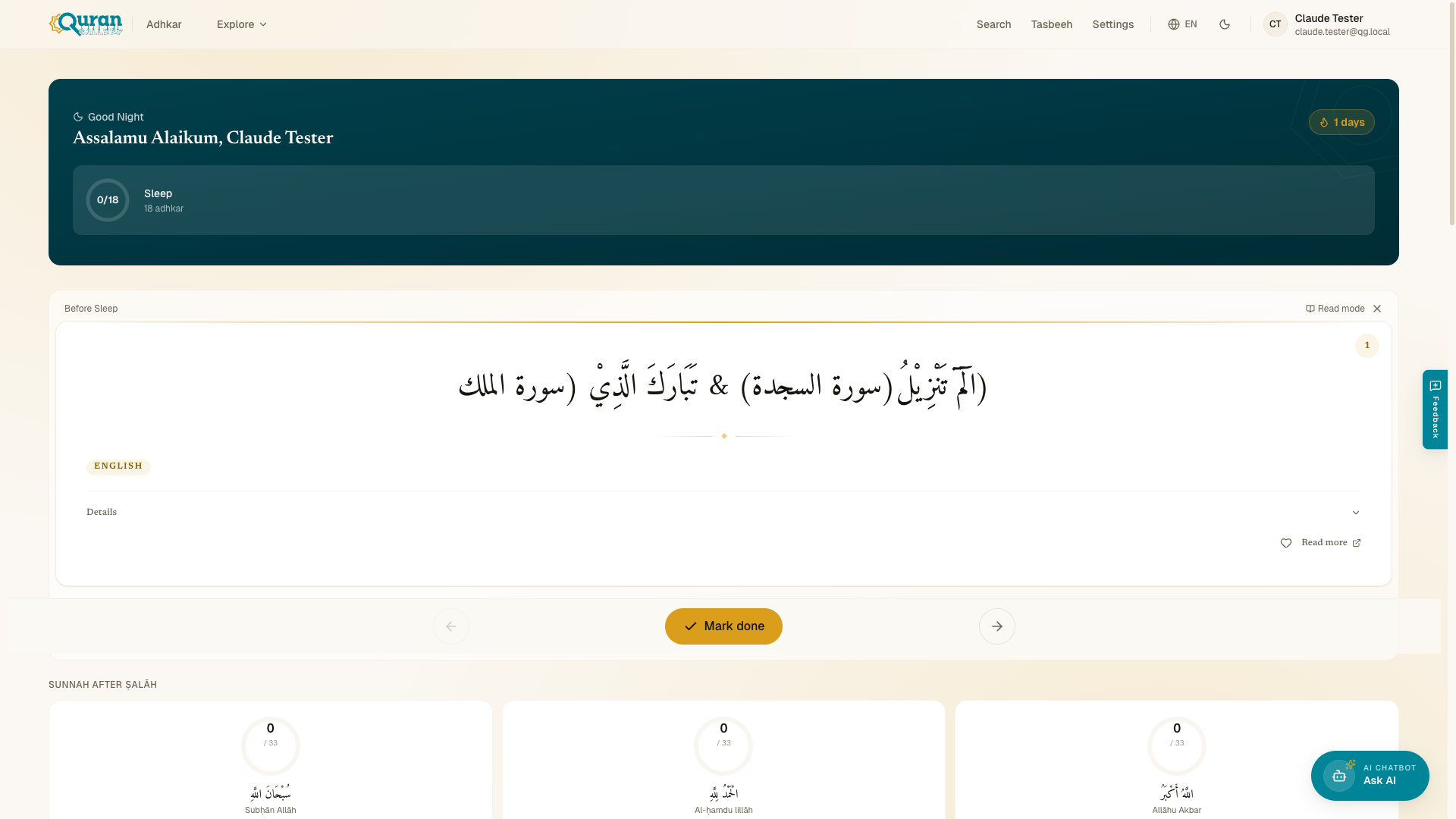
Open qurangallery.com/adhkar to read the morning and evening adhkar with the Arabic, transliteration, translation, source and audio of each dhikr in one place, and to keep a daily streak. It is free, shows no ads, and you don’t need an account to read or to count.
The home page shows the collection for this hour under For this hour, with Begin (or Continue once you have started). Each collection is one list you read from top to bottom, with a counter on each dhikr.
Common tasks
- Find adhkar by category, feeling or book
- Adhkar audio with Arabic text and translation
- Hisnul Muslim online: all 132 chapters with audio
- Tasbeeh counter for 33, 33, 34 after prayer
- Adhkar streak, progress and data export
- Daily adhkar reminders in your phone calendar
- Free adhkar app: no ads, no account, read offline
- Adhkar sources and hadith gradings explained
- Find a dua by feeling: anxiety, grief, gratitude
- Build a morning and evening adhkar habit
What each dhikr shows
- The Arabic text.
- Transliteration, the Arabic in Latin script, for when you are still learning the words.
- A translation in the language you read the site in. You can add a second translation under it.
- The source: the book and number, with a link to the printed page. See Sources and gradings.
- Listen, a recording of the Arabic. The voice is AI (synthetic), checked word by word against the Arabic; a recording that failed the check plays labelled as not verified. See Listen to every dhikr.
What’s inside
The corpus holds 1,156 adhkar and duas.
- Daily sets by time of day: Morning, Evening and Sleep, plus adhkar after prayer and for travel.
- 91 collections in 15 sections, from prayer and travel to food, home, rain and hardship. See Find adhkar and duas.
- Duas for 30 feelings: on the home page, How are you feeling? gathers the duas for when you are anxious, grieving, grateful and more.
- Hisnul Muslim (Fortress of the Muslim) chapter by chapter, all 132 chapters. See Hisnul Muslim chapters.
- Du’a of the Day: one supplication each day, with Open this dua and Share, and a Previous Du’as list.
- Tasbeeh counter: the after-prayer tasbih in four reported forms, your own goals, a full-screen Focus mode, and a counter you share with family. See Tasbeeh counter.
- Seven languages: English, Arabic, Urdu, Indonesian, Turkish, Bengali and French.
A compact version of a collection can also appear inside other Quran Gallery apps (such as the AI chatbot), with a link to open the full set here.
Reading a collection
Open a collection, say Morning Adhkar, and read it from the top. A progress line shows {done} of {total} said today. Contents lets you jump to any dhikr in the list, and Listen to all plays the whole collection, each dua as many times as it is said.
When you reach the end, a completion screen reads Mā shā’ Allāh with “Morning Adhkar complete”. From there you can Practice again or tap Done to go home.
With or without an account
Without an account, your streak, history and tasbeeh counts are saved in this browser. You can export them, import them on another device, or clear them. See Offline and privacy.
If you sign in with your Quran Gallery account, the home page greets you by name (Assalamu Alaikum) and shows your streak, your Favorites, Tasbeeh and Progress. Your progress and tasbeeh goals are then kept with your account. Saving favorites and starting a group counter need an account.
Where to go next
- Find adhkar and duas: daily sets, collections, feelings, search, and what a dhikr card holds.
- Listen to every dhikr: Listen, Listen to all, and how the AI voice is checked.
- Hisnul Muslim chapters: the book chapter by chapter.
- Tasbeeh counter: after-prayer forms, goals, focus mode and the family counter.
- Progress and settings: streaks, stats, transliteration, second translation and time detection.
- Daily reminders: a calendar file at the times you choose.
- Offline and privacy: what works without a connection and where your data stays.
- Sources and gradings: what the book, number and grading on each dhikr mean.
- Find a dua by feeling: the 30 feelings and the duas gathered for each.
- Build a morning and evening adhkar habit: a set, a reminder, a streak and your own routine.
Next steps
Questions
Is there a free adhkar app with no ads and no account?
Yes. Daily Adhkar at qurangallery.com/adhkar is free and shows no ads. You can read every dhikr and use the tasbeeh counter without signing in.
Does it read the adhkar aloud?
Yes. Every dhikr has a Listen button, and a collection can be played through with Listen to all. The voice is AI (synthetic), checked word by word against the Arabic, and a recording that failed the check is labelled unverified.
Does it work offline?
Pages you have opened once open again without a connection, and counting keeps working. A page you have not opened yet, and the audio, need a connection.
Which languages is it in?
Seven: English, Arabic, Urdu, Indonesian, Turkish, Bengali and French. The translation follows the site language, and you can add a second translation in Settings.
What is on the site besides the morning and evening adhkar?
Adhkar for sleep, after prayer, travel, food, hardship and more (91 collections in all), duas for 30 feelings, Hisnul Muslim chapter by chapter, a tasbeeh counter with a family counter, and calendar reminders.
Where do the adhkar come from?
Each dhikr names the book and number it comes from, with a link to the printed page. Where a grading is shown it is quoted from the source with the scholar named; the site does not grade hadith itself.